

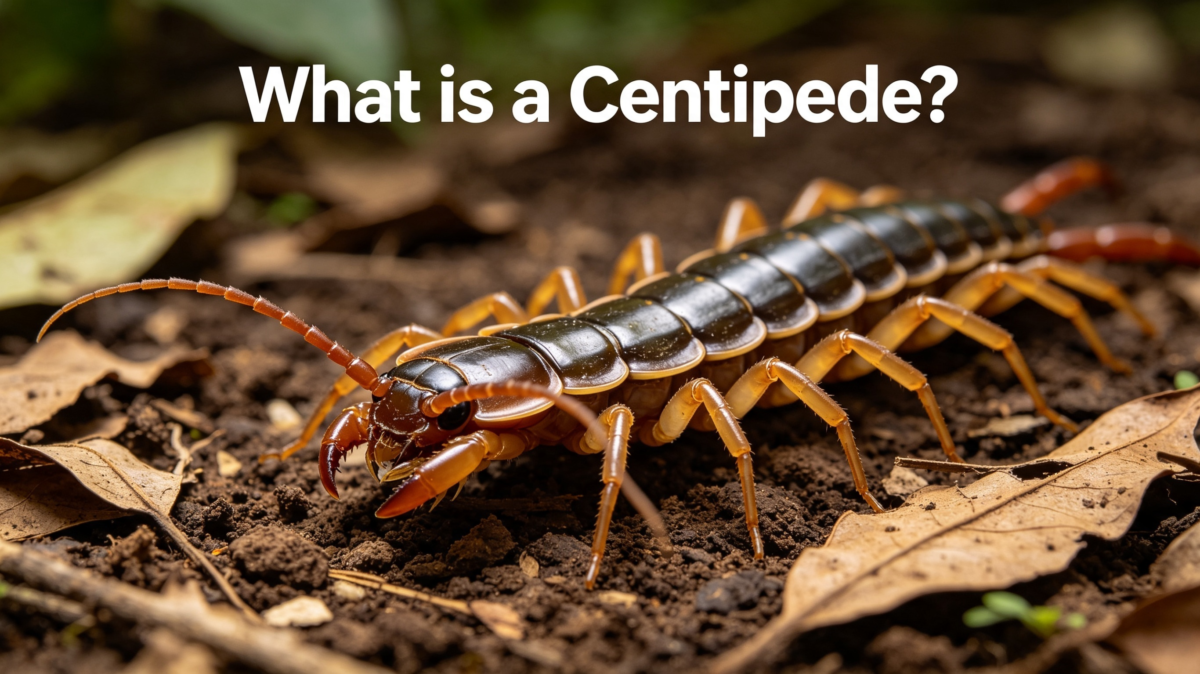
What is a Centipede?
When we hear the word "centipede," our minds immediately conjure an image of a terrifying, multi-legged nightmare scurrying across a dark floor. However, beyond the initial shock of its appearance lies one of the most fascinating and ancient groups of animals on Earth. To truly understand what a centipede is, we must look past the fear and examine the biology, evolutionary history, and ecological significance of these remarkable predators. Far from being mere pests, centipedes are highly specialized biological machines that have mastered the art of survival in the shadows.
The Etymological Misnomer: The Truth About Their Legs
The word "centipede" is derived from the Latin words centum (meaning "hundred") and pes or pedis (meaning "foot"). Despite this name, the idea that a centipede has exactly one hundred legs is a complete myth. In reality, no known species of centipede possesses exactly one hundred legs. Instead, they always have an odd number of leg pairs.
Depending on the species, a centipede can have anywhere from 15 to over 177 pairs of legs. For example, the common House Centipede has exactly 15 pairs (30 legs), while some soil-dwelling species can have well over 300 legs in total. Furthermore, centipedes undergo a unique developmental process called anamorphic development. They do not hatch with their full complement of legs; instead, they add new body segments and additional pairs of legs each time they molt and grow, until they reach their species-specific maximum.
The Architecture of a Predator: Flattened and Flexible
Anatomically, centipedes belong to the class Chilopoda within the subphylum Myriapoda. One of their most defining physical characteristics is their body shape. Unlike their cousins, the millipedes, which have round, cylindrical bodies, centipedes are dorsoventrally flattened—meaning they are compressed from top to bottom.
This flattened physique is not just for show; it is a crucial evolutionary adaptation. It allows centipedes to effortlessly squeeze into incredibly tight spaces, such as beneath tree bark, deep into soil crevices, and into the narrow gaps of leaf litter. This body plan turns the complex, cluttered environment of the forest floor into a highly navigable hunting ground, allowing them to pursue prey into hiding spots that other predators cannot reach.
The Forcipules: Venomous Pincers, Not Mouthparts
Perhaps the most misunderstood feature of the centipede is its "fangs." When observing the head of a centipede, one might assume the sharp, claw-like structures at the front are its mouthparts. In reality, these structures are called forcipules, and they are actually the modified first pair of walking legs.
Over millions of years of evolution, these front legs transformed into hollow, pincer-like appendages connected to internal venom glands. When a centipede strikes, it drives these forcipules into its target, injecting a complex cocktail of neurotoxins and enzymes. This venom is designed to rapidly paralyze or kill prey, preventing it from escaping or fighting back. The true mouthparts of the centipede are located just behind the forcipules and are used solely for manipulating and consuming the liquefied tissues of the paralyzed victim.
A Strictly Carnivorous Lifestyle
While many creatures that share the centipede's habitat—such as millipedes, earthworms, and woodlice—are detritivores that feed on decaying plant matter, centipedes are strictly carnivorous. They are the apex predators of the invertebrate world. They do not scavenge; they actively hunt.
Using their highly sensitive antennae and vibration-detecting body hairs, centipedes track down a wide variety of prey. Their diet primarily consists of insects, spiders, worms, and other small invertebrates. However, larger species are formidable hunters capable of taking down much bigger targets, including small scorpions, frogs, lizards, and even small mice. By keeping these populations in check, centipedes play an indispensable role in maintaining the ecological balance of terrestrial ecosystems.
An Ancient Legacy: 400 Million Years of Survival
What truly sets the centipede apart is its incredible evolutionary longevity. Centipedes are among the oldest known terrestrial animals on the planet. Fossil evidence indicates that the earliest myriapod ancestors of centipedes made the monumental transition from the ocean to land during the Late Silurian period, over 400 million years ago.
This means that centipedes were crawling across the prehistoric landscape long before the first dinosaurs walked the Earth, and long before the first mammals appeared. While countless other species have risen and fallen victim to mass extinction events, the centipede's basic anatomical blueprint—a flattened body, numerous legs, and venomous forcipules—has remained remarkably successful and largely unchanged. They are living relics of a bygone era, perfectly adapted to the dark, damp micro-worlds they have called home for hundreds of millions of years.
Conclusion: More Than Just a "Creepy Crawly"
So, what is a centipede? It is not merely a scary bug that invades our basements. It is a highly evolved, venomous predator with a lineage that stretches back to the dawn of terrestrial life. With its odd-numbered legs, flattened armor, and ancient hunting tactics, the centipede is a masterpiece of natural selection. By understanding what a centipede truly is, we can replace our instinctual fear with a deep appreciation for one of nature's most enduring and fascinating survivors.