

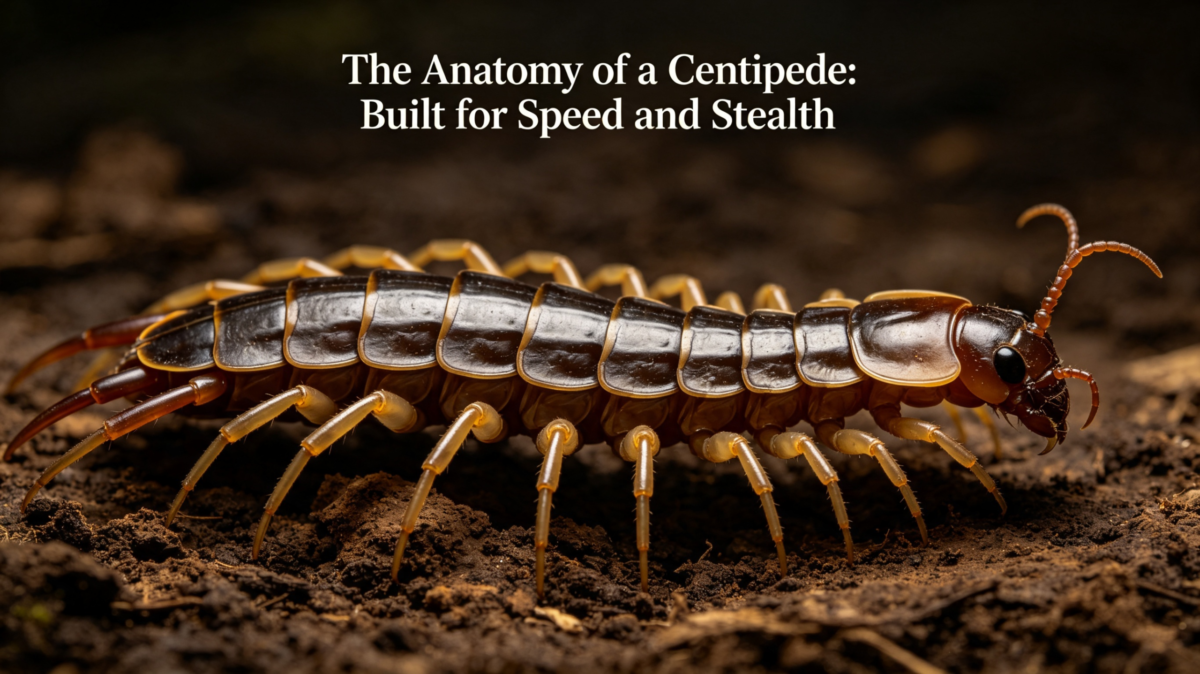
The Anatomy of a Centipede: Built for Speed and Stealth
When observing a centipede darting across a forest floor or scurrying along a basement wall, it is easy to view it merely as a creepy, multi-legged anomaly. However, beneath its unsettling exterior lies a masterpiece of evolutionary engineering. The anatomy of a centipede is perfectly optimized for a life of hunting in the dark, combining remarkable speed with unparalleled stealth. Every segment, limb, and sensory organ of a centipede has been finely tuned by millions of years of natural selection to make it one of the most efficient invertebrate predators on the planet.
The Chassis: Dorsoventral Flattening and Flexible Armor
The most immediate visual characteristic of a centipede is its body shape. Unlike the cylindrical, tube-like body of a millipede, a centipede’s body is dorsoventrally flattened (compressed from top to bottom). This physical trait is not merely aesthetic; it is a crucial adaptation for stealth and survival. This flattened profile allows the centipede to slip effortlessly into incredibly narrow crevices, beneath loose bark, and deep into the tight spaces of soil and leaf litter, effectively disappearing from the sight of both predators and prey.
Protecting this flattened body is an exoskeleton made of chitin. However, unlike many insects, the centipede's exoskeleton lacks a thick, waxy outer layer. While this makes them highly vulnerable to water loss (desiccation), it grants their bodies a remarkable degree of flexibility. The exoskeleton is composed of overlapping hardened plates called sclerites. These plates act like overlapping roof shingles or medieval armor, providing protection against physical damage and predatory bites while still allowing the body to bend, twist, and undulate smoothly as it navigates complex terrain.
The Propulsion System: Engineering for Rapid Movement
The namesake feature of the centipede is, of course, its legs. With one pair of long, jointed legs attached to nearly every body segment, centipedes possess a highly complex locomotion system. The legs are not merely used for walking; they are engineered for explosive speed.
When a centipede moves, it does not just move its legs randomly. It utilizes a highly coordinated movement pattern known as a metachronal wave. The legs on one side of the body move in a sequential, wave-like rhythm, pushing the body forward with incredible efficiency. This coordination allows them to achieve startling speeds relative to their size. The House Centipede (Scutigera coleoptrata), for instance, can reach speeds of up to 1.3 feet per second, which is exceptionally fast for an arthropod of its size, allowing it to easily outrun and intercept fleeing prey.
Furthermore, the legs are equipped with tiny claws at their tips, providing excellent grip on a variety of surfaces, from smooth indoor tiles to rough, damp bark. Despite their speed, the lightweight nature of their legs and the soft, silent placement of their footfalls contribute to their stealth, allowing them to ambush prey without alerting them.
The Weaponry: Forcipules and Venom Delivery
The most formidable and distinctive anatomical feature of the centipede is located at the very front of its body. The first pair of legs has been evolutionarily modified into a pair of highly specialized, claw-like appendages known as forcipules. It is a common misconception that these are mouthparts; in reality, they are modified legs that function as venom-delivering weapons.
Each forcipule consists of a thick basal segment and a curved, sharp claw. Inside these segments lie venom glands. When a centipede strikes, it swings its forcipules forward with lightning speed, piercing the exoskeleton or skin of its prey. The venom is then injected directly into the victim. This venom is a complex cocktail of neurotoxins, enzymes, and proteins designed to rapidly paralyze or kill the prey. The mechanical leverage of the forcipules allows even smaller centipedes to subdue prey much larger than themselves, pinning them down while the venom takes effect.
The Sensor Array: Navigating a World of Darkness
Speed and weaponry are useless if a predator cannot find its target. Because centipedes are predominantly nocturnal and spend their lives in dark, subterranean, or heavily shaded environments, their sensory anatomy is highly advanced.
The most prominent sensory organs are their antennae. Centipedes possess a single pair of long, highly segmented antennae that sweep back and forth as they move. These antennae are densely packed with chemoreceptors (for tasting and smelling) and mechanoreceptors (for touch). They allow the centipede to map its immediate surroundings, detect the chemical trails of prey, and feel for physical obstacles in total darkness.
In addition to antennae, many centipedes are covered in trichobothria—specialized, hair-like sensory structures that are exquisitely sensitive to minute air currents and vibrations. If a cricket jumps or a spider walks nearby, the trichobothria detect the subtle displacement of air, alerting the centipede to the exact location of the movement. While some species possess simple eyes (ocelli) that can only detect light and dark, and a few have more complex compound eyes, vision is generally secondary to touch and vibration in the centipede's sensory hierarchy.
Internal Mechanics: Respiration and Decentralized Control
Internally, the centipede's anatomy is equally adapted to its predatory lifestyle. They breathe through a tracheal system. Unlike insects that often have a highly centralized tracheal network, centipedes have spiracles (breathing pores) located along the sides of their body segments. This decentralized respiratory system ensures that oxygen is delivered efficiently to all parts of their elongated body, fueling the high energy demands of their rapid movements.
Their nervous system is also uniquely structured. While they have a brain located in the head, a significant portion of their nervous system consists of a ventral nerve cord with a ganglion (a cluster of nerve cells) in almost every body segment. This decentralized neural architecture allows for incredibly fast, localized reflex actions. If a leg on the rear of the body encounters an obstacle or a threat, the local ganglion can trigger a reflexive withdrawal without waiting for a signal to travel all the way to the brain and back. This ensures that their movements remain fluid and uninterrupted.
Conclusion: A Masterpiece of Predatory Design
The anatomy of a centipede is a testament to the power of evolutionary specialization. From its flattened, flexible armor and lightning-fast legs to its venomous forcipules and highly sensitive sensory array, every aspect of its physical form serves a singular purpose: to hunt effectively in the shadows. They are not merely surviving relics of a bygone era; they are perfectly calibrated biological machines, built for speed, stealth, and survival in the complex micro-worlds they inhabit.