

Reproduction and Life Cycle of Centipedes
The reproductive strategies and life cycles of centipedes are as fascinating as their predatory behaviors. Unlike many other arthropods that engage in direct mating or abandon their eggs immediately after laying them, centipedes exhibit a highly unique and complex approach to reproduction. Their life cycle is characterized by indirect copulation, remarkable maternal devotion, and a prolonged developmental process that allows them to grow continuously throughout their lives. Understanding the reproductive biology of centipedes provides deep insights into their evolutionary success and their ability to thrive in diverse and often challenging environments.
The Mating Ritual: Indirect Copulation
One of the most distinctive aspects of centipede reproduction is that they do not engage in direct copulation. Instead, they utilize a process known as indirect sperm transfer. The mating process usually begins with a complex courtship ritual, which can vary significantly depending on the species.
In many species, the male will spin a small, silken web or thread on the ground or on a leaf. He then deposits a small, gelatinous packet of sperm, called a spermatophore, onto this web. After securing the spermatophore, the male will gently guide the female toward it, often using his antennae and legs to coax her into the correct position. The female then lowers her reproductive opening to pick up the spermatophore, internalizing the sperm to fertilize her eggs. In some other species, particularly larger tropical ones, the male may simply deposit the spermatophore on the ground and physically drag or push the female over it. This indirect method ensures that the delicate sperm is protected from the dry external environment until it is safely inside the female.
Egg Laying and the Crucial Role of Moisture
Following successful fertilization, the female centipede must find a suitable location to lay her eggs. Because centipedes are highly susceptible to desiccation, the choice of a nesting site is critical for the survival of the offspring. The female typically seeks out dark, humid, and sheltered microhabitats. Common nesting sites include deep within the soil, inside rotting logs, beneath large stones, or in thick layers of damp leaf litter.
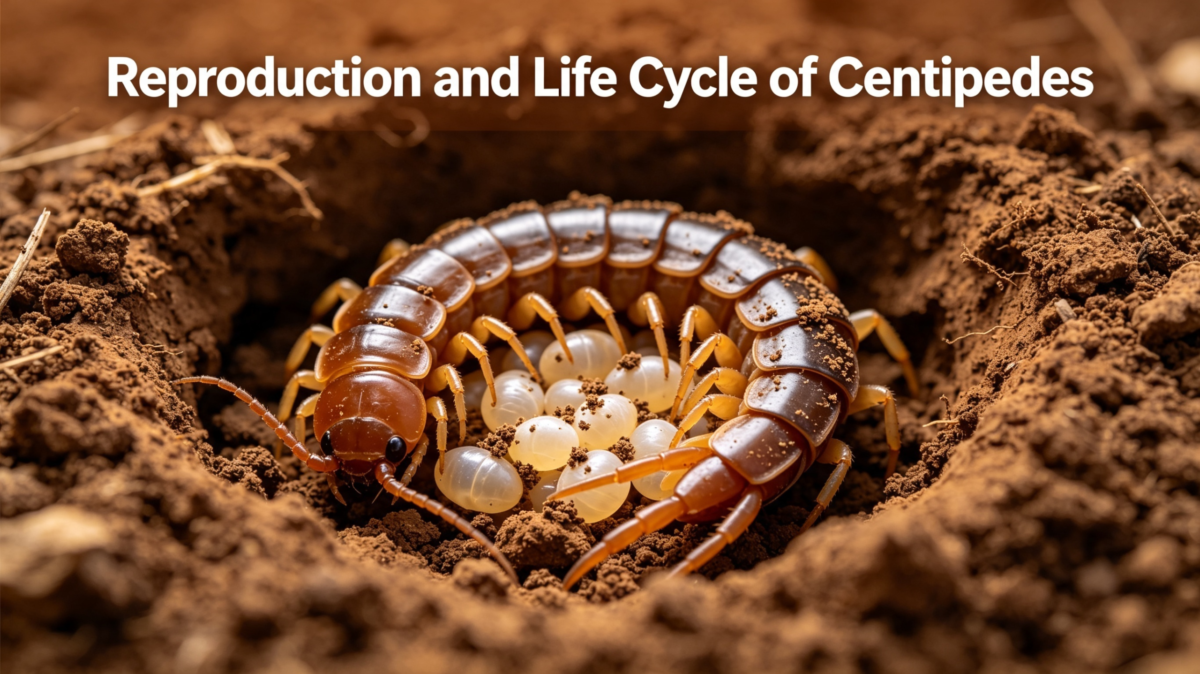
The female will often excavate a small cavity in the soil or wood to create a secure nest. She then lays her eggs in a small cluster. The number of eggs laid varies greatly among species; some may lay only a dozen, while larger species can lay up to a hundred or more. The high humidity of the chosen nesting site is absolutely essential, as the eggs lack a hard, waterproof shell and will quickly dry out and die if exposed to arid conditions.
Remarkable Maternal Care
Perhaps the most extraordinary aspect of centipede reproduction is the level of maternal care they provide, which is exceptionally rare among invertebrates. Once the eggs are laid, the female does not abandon them. Instead, she remains with the clutch, fiercely guarding them against predators such as ants, spiders, and other soil-dwelling creatures.
Even more remarkably, the mother centipede will constantly lick and clean her eggs. This behavior is not merely for hygiene; it is a vital survival mechanism. By coating the eggs in her saliva, she protects them from fungal and bacterial infections, which are highly prevalent in the damp, dark environments where they nest. This maternal dedication continues even after the eggs hatch. The mother will stay with her newly hatched young, protecting them through their early, vulnerable life stages until they complete their first molt and become independent enough to fend for themselves.
Hatching and Anamorphic Development
When centipede eggs hatch, the young do not look like miniature versions of the adults. The developmental process of centipedes is primarily anamorphic, meaning they hatch with fewer body segments and fewer legs than they will have as adults. The exact number of legs a hatchling possesses depends on the specific order of the centipede, but it is always significantly less than the adult count.
For example, hatchlings of the House Centipede (Scutigera coleoptrata) emerge with only four pairs of legs. As they grow, they will undergo a series of molts, adding more body segments and additional pairs of legs with each stage. In contrast, some soil centipedes hatch with a specific number of leg pairs and add more in subsequent molts until they reach their species' maximum. This gradual addition of segments and legs allows the young centipedes to remain small and agile, perfectly suited for hunting microscopic prey in the tight spaces of the soil.
The Molting Process and Lifespan
Growth in centipedes is achieved through molting, the process of shedding their rigid exoskeleton to reveal a new, larger one underneath. During their juvenile stages, centipedes molt frequently to accommodate their rapid growth. However, unlike many insects that stop molting once they reach adulthood, many centipede species continue to molt throughout their entire lives.
This continuous molting process means that older centipedes can occasionally add more body segments and legs even after reaching sexual maturity. The frequency of molting slows down as the centipede ages, but the ability to grow continuously is a unique feature of myriapod biology.
Because of their protected lifestyle and continuous growth, centipedes have relatively long lifespans for arthropods. While many insects live for only a few months, centipedes can live for several years. The House Centipede, for instance, can live up to five or six years in a favorable indoor environment. Larger tropical species have been known to live for over a decade in captivity, provided they have adequate food, moisture, and protection from predators.
Conclusion: A Life Cycle of Dedication and Resilience
The reproduction and life cycle of centipedes highlight a level of biological sophistication that challenges our typical perceptions of "creepy crawlies." From the intricate dance of indirect copulation to the selfless, fungus-fighting maternal care, centipedes invest heavily in the survival of their offspring. Their anamorphic development and continuous molting allow them to adapt their physical form as they grow, ensuring they remain efficient hunters at every stage of life. This resilient and dedicated life cycle has allowed centipedes to persist as formidable predators for hundreds of millions of years, securing their place as one of nature's most enduring evolutionary success stories.