

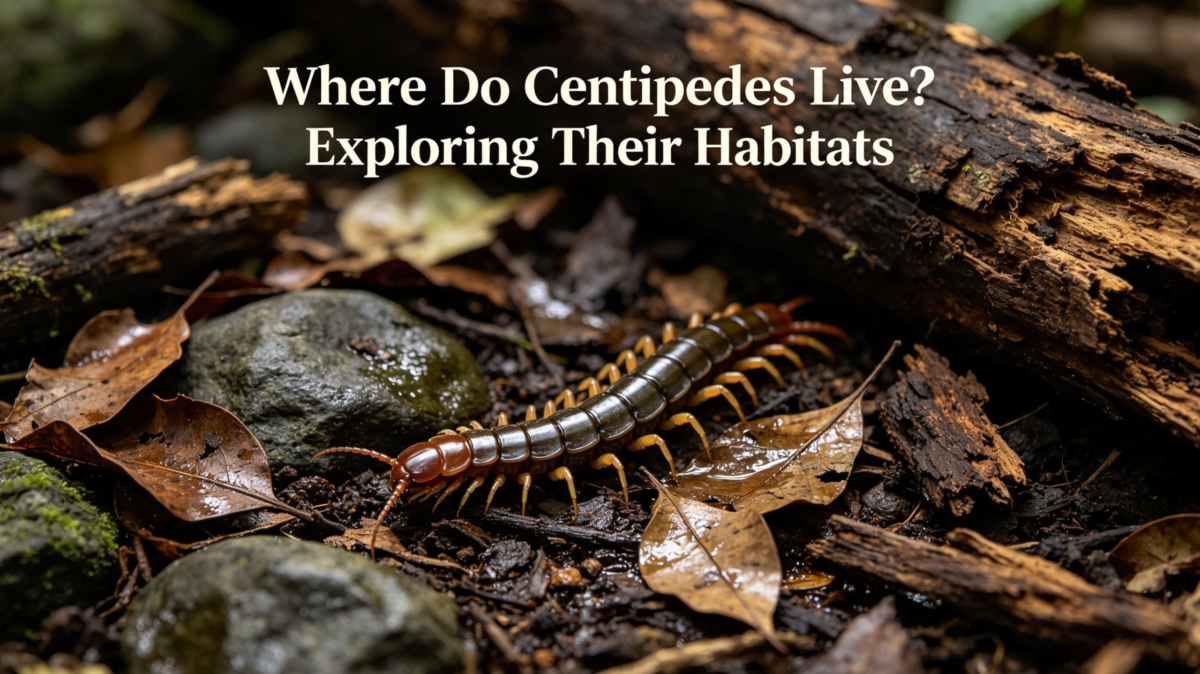
Where Do Centipedes Live? Exploring Their Habitats
Centipedes are among the most widely distributed arthropods on Earth, inhabiting nearly every terrestrial ecosystem across the globe. From the steamy depths of tropical rainforests to the arid expanses of deserts, from the dark recesses of cave systems to the basements of human homes, these ancient predators have found ways to thrive in remarkably diverse environments. However, despite their adaptability, centipedes share one fundamental requirement that dictates where they can and cannot live: moisture. Understanding the habitats of centipedes reveals not only their ecological preferences but also the evolutionary strategies they have developed to survive in an ever-changing world.
The Moisture Imperative: Why Centipedes Need Damp Environments
To understand where centipedes live, one must first understand their greatest vulnerability. Unlike insects, which possess a waxy outer layer on their exoskeleton that helps retain water, centipedes have a relatively thin and permeable cuticle. This makes them highly susceptible to desiccation, or the loss of water through evaporation. A centipede exposed to dry air can lose a significant portion of its body water in a matter of hours, leading to rapid dehydration and death.
This biological limitation is the single most important factor in determining centipede habitat distribution. They must live in environments where the humidity is consistently high, or where they can access moist microhabitats that protect them from drying out. This is why centipedes are rarely found in open, sun-exposed areas, and why they are predominantly nocturnal, emerging to hunt when the air is cooler and more humid.
Forest Floors: The Kingdom of Leaf Litter
The most iconic and species-rich habitat for centipedes is the forest floor, particularly in temperate and tropical forests. Here, the ground is covered with a thick layer of decomposing leaves, twigs, and organic matter known as leaf litter. This layer serves as a perfect microhabitat for centipedes for several reasons:
- Moisture Retention: The leaf litter acts like a sponge, absorbing rainwater and maintaining a consistently humid environment beneath the surface, even during dry periods.
- Temperature Regulation: The layer insulates the soil from extreme temperatures, keeping it cool during the day and warm at night.
- Abundant Prey: The decomposing organic matter supports a vast community of insects, spiders, worms, and other invertebrates, providing a reliable food source for predatory centipedes.
- Cover and Concealment: The complex structure of the leaf litter provides countless hiding places, allowing centipedes to ambush prey and escape from predators such as birds and small mammals.
In tropical rainforests, where the humidity is near 100% and the leaf litter is deep and rich, centipede diversity reaches its peak. Species from the order Scolopendromorpha, including some of the largest and most venomous centipedes, dominate these ecosystems. In temperate forests, smaller species from the order Lithobiomorpha are more common, navigating the seasonal changes by retreating deeper into the soil during winter.
Beneath the Surface: Soil and Subterranean Life
Many centipede species have adapted to a life entirely or partially underground, burrowing into the soil to escape the harsh conditions of the surface. The soil provides a stable environment with high humidity, consistent temperatures, and protection from predators and extreme weather.
The order Geophilomorpha, commonly known as soil centipedes or snake-like centipedes, are the most specialized for this subterranean lifestyle. These centipedes have elongated, worm-like bodies that can have up to 191 pairs of legs, allowing them to move efficiently through the narrow tunnels of the soil. They lack eyes entirely, as vision is unnecessary in the pitch-black environment underground. Instead, they rely entirely on their sensitive antennae and body hairs to navigate and detect prey such as insect larvae, earthworms, and other soil-dwelling invertebrates.
Soil centipedes play a crucial role in soil ecology. By preying on herbivorous insects and larvae, they help regulate populations that might otherwise damage plant roots. Their burrowing activity also contributes to soil aeration and the mixing of organic matter, improving soil health.
The Hidden World: Under Rocks, Logs, and Debris
One of the most common places to find centipedes is beneath objects that create sheltered, humid microhabitats. Rocks, logs, pieces of bark, and other debris lying on the ground serve as ideal refuges for centipedes. These objects trap moisture from the soil and prevent it from evaporating, creating a pocket of high humidity that centipedes require.
During the day, when temperatures are higher and the air is drier, centipedes retreat beneath these objects to rest and conserve moisture. At night, they emerge to hunt in the surrounding area. This behavior is particularly common in gardens, parks, and woodlands, where people often encounter centipedes when turning over rocks or moving logs.
Rotting logs are especially attractive to centipedes. The decaying wood is soft, moist, and rich in fungi and insects, providing both shelter and a reliable food source. Many species of centipedes will spend their entire lives within a single rotting log, never venturing far from its protective embrace.
The Dark Frontier: Caves and Karst Systems
Caves represent one of the most extreme and specialized habitats for centipedes. The subterranean world of caves is characterized by perpetual darkness, stable temperatures, and high humidity—conditions that are ideal for centipedes but challenging for most other animals.
Cave-dwelling centipedes, often referred to as troglobites, have evolved unique adaptations to survive in this environment. Many cave species are eyeless or have greatly reduced eyes, as there is no light to detect. They often have elongated bodies and longer antennae, enhancing their ability to navigate and detect prey in the dark. Their coloration is typically pale or translucent, as there is no need for camouflage or protection from ultraviolet radiation.
In caves, centipedes are often apex predators, feeding on insects, spiders, and other invertebrates that inhabit the cave system. Some larger species, such as those found in tropical cave systems, have been known to prey on small vertebrates, including bats. The Amazonian Giant Centipede (Scolopendra gigantea), for example, has been documented hunting bats by clinging to cave ceilings and snatching them from the air as they roost.
Surviving the Dry: Adaptations to Arid Environments
While centipedes are most diverse in moist environments, some species have managed to colonize arid and semi-arid regions, including deserts and scrublands. This is no small feat, given their vulnerability to desiccation. To survive in these harsh environments, desert-dwelling centipedes have developed a range of behavioral and physiological adaptations.
Behaviorally, desert centipedes are strictly nocturnal, emerging only at night when temperatures are cooler and humidity is relatively higher. During the day, they retreat deep underground, burrowing into the soil where the moisture content is higher and temperatures are more stable. Some species can burrow several feet below the surface to reach these humid microclimates.
Physiologically, some desert centipedes have evolved to reduce water loss more effectively than their forest-dwelling relatives. They may have a slightly thicker cuticle or the ability to reabsorb water from their waste, minimizing water loss through excretion. Additionally, their prey in arid environments often includes other arthropods that are adapted to dry conditions, such as scorpions and beetles, which provide both food and a source of moisture.
Into the Human World: Centipedes in Urban and Domestic Settings
As human settlements expand into natural habitats, centipedes have increasingly found themselves sharing space with people. While they are not pests in the traditional sense—they do not eat human food, damage property, or reproduce indoors—centipedes can occasionally be found in houses, particularly in damp areas such as basements, bathrooms, and crawl spaces.
The most common centipede encountered in homes is the House Centipede (Scutigera coleoptrata). Originally from the Mediterranean region, this species has spread worldwide through human trade and travel. House centipedes are well-adapted to indoor environments, where they find the humidity they need in damp corners and an abundance of prey in the form of household insects like cockroaches, silverfish, and spiders.
The presence of centipedes in a home is often an indicator of excess moisture or a large population of other insects. To reduce their presence, homeowners can focus on reducing indoor humidity using dehumidifiers, fixing leaks, and sealing cracks and gaps where centipedes might enter from the outside. However, it is worth noting that house centipedes are beneficial creatures that help control other pests, and their presence is generally harmless to humans.
Global Distribution: Centipedes on Every Continent
Centipedes are found on every continent except Antarctica, where the extreme cold and lack of suitable habitats make survival impossible. They are most diverse in tropical and subtropical regions, where the warm, humid conditions provide ideal living conditions. However, they can also be found in temperate regions, where they adapt to seasonal changes by retreating deeper into the soil during winter.
The distribution of centipede species is influenced by a combination of historical factors, such as continental drift and evolutionary history, and current environmental conditions, such as climate and habitat availability. Some species have very narrow ranges, restricted to specific mountain ranges or islands, while others, like the House Centipede, have achieved a nearly global distribution through human activity.
Conclusion: Masters of the Microhabitat
Centipedes are creatures of the shadows, thriving in the damp, dark corners of the world that many other animals avoid. From the rich leaf litter of tropical forests to the depths of subterranean caves, from the soil beneath our feet to the basements of our homes, they have found ways to survive and flourish in a remarkable variety of habitats. Their success is a testament to their evolutionary adaptability and their ability to exploit the resources available in the microhabitats they occupy. By understanding where centipedes live and why, we gain a deeper appreciation for these ancient predators and the vital role they play in the ecosystems they inhabit.