

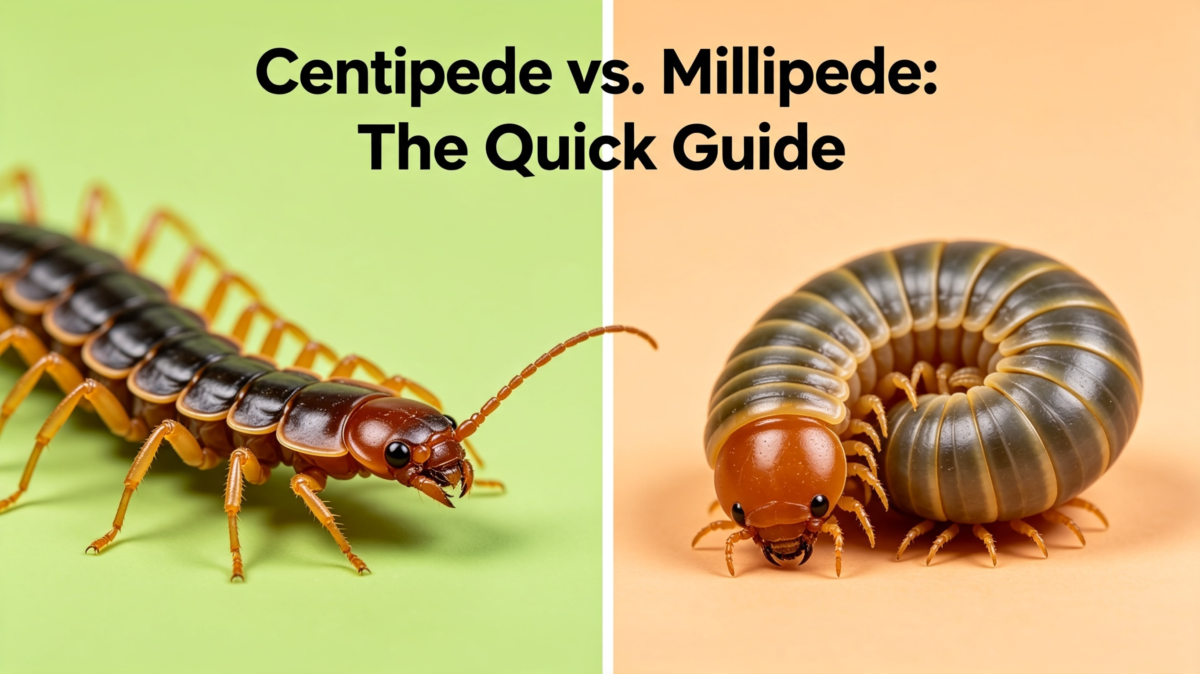
Centipede vs. Millipede: The Quick Guide
When you turn over a rock in the garden or step into a damp basement, you might be startled by the sudden appearance of a long, multi-legged creature. For most people, the immediate reaction is a mix of disgust and confusion, followed by the inevitable question: "Is it a centipede or a millipede?" Because both belong to the subphylum Myriapoda and share a superficial resemblance, they are frequently lumped together in the public imagination. However, biologically, anatomically, and behaviorally, they are entirely different creatures. Understanding the distinctions between these two myriapods is not only fascinating but also practical, as their interactions with humans and their roles in the ecosystem are vastly different.
The Leg Count: The Most Definitive Identifier
The most reliable and easiest way to tell a centipede from a millipede is by examining their legs and how those legs attach to their bodies. Despite their names implying "hundred" and "thousand" legs, neither creature actually has that exact number, but the arrangement of their legs is a dead giveaway.
Centipedes: One Pair Per Segment
Centipedes possess exactly one pair of legs attached to each body segment. These legs are long, extend outward and slightly backward from the sides of their bodies, and are highly visible. Because the legs are so long, they often stick out past the width of the body itself. The very first pair of legs, located just behind the head, is modified into venomous, claw-like pincers called forcipules.
Millipedes: Two Pairs Per Segment
Millipedes, on the other hand, have two pairs of legs on almost every body segment. This occurs because their body segments are evolutionarily fused together in pairs to form single rings called diplosegments. Because they have twice as many legs packed into each visible ring, their legs are much shorter. Instead of sticking out to the sides, millipede legs point downward and are often tucked neatly beneath the body, giving them the appearance of a moving, multi-rowed oar boat.
Body Shape and Posture: Flat vs. Round
If counting legs in the field is too difficult, the overall body shape provides an immediate visual clue.
- Centipedes have a dorsoventrally flattened body, meaning they are compressed from top to bottom. This gives them a somewhat streamlined, almost leech-like or ribbon-like appearance. This flat profile is an evolutionary adaptation that allows them to slip effortlessly into tight crevices, under bark, and into narrow soil cracks to hunt or hide.
- Millipedes have a distinctly cylindrical or tubular body shape, resembling a thick worm, a piece of wire, or a tiny pill. While a few species might be slightly flattened, the vast majority appear round, robust, and heavily armored. This shape is designed for burrowing and pushing through dense soil and decaying wood.
Movement and Speed: The Sprinter vs. The Crawler
The way these creatures move reflects their entirely different ecological lifestyles and physical builds.
Centipedes are built for speed and agility. Their long legs and flattened bodies allow them to be incredibly fast. When disturbed, a centipede's first instinct is to sprint away at startling speeds, darting erratically across the floor or up a wall. They are the sprinters of the myriapod world, constantly on the move as they actively patrol their territory for live prey.
Millipedes are slow, deliberate, and methodical. Their short, downward-pointing legs are designed for power and pushing through dense debris rather than running. When a millipede moves, it creates a highly visible, rippling, wave-like motion that travels down its body. They are the slow, steady crawlers of the undergrowth, taking their time as they graze on decaying matter.
Diet and Ecological Role: Predator vs. Recycler
Perhaps the most crucial difference between the two lies in what they eat, which dictates their mouthparts and their vital role in the ecosystem.
Centipedes: The Carnivorous Hunters
Centipedes are strictly carnivorous. They are active predators that feed on live prey, including insects, spiders, worms, and occasionally small vertebrates. They rely on their speed, keen senses, and venomous forcipules to capture and paralyze their meals. In the ecosystem, they act as apex invertebrate predators and natural pest controllers, keeping insect populations in check.
Millipedes: The Detritivore Decomposers
Millipedes are primarily detritivores. They feed on decaying organic matter, such as rotting leaves, dead wood, and plant debris. They possess strong, horizontal mandibles designed for chewing and grinding tough plant material. In the ecosystem, millipedes are vital decomposers. They break down dead plant matter, turning it into nutrient-rich frass (feces) that returns essential minerals to the soil, promoting plant growth.
Defense Mechanisms: Venom vs. Chemical Warfare
When threatened, centipedes and millipedes employ entirely different defensive strategies, which is highly relevant if you encounter them in your home.
Centipedes rely on their speed to flee. However, if cornered, stepped on, or handled, they will aggressively defend themselves using their venomous forcipules to bite. While a centipede bite is rarely deadly to humans, it can be quite painful, causing localized swelling and throbbing that lasts for a day or two.
Millipedes cannot bite humans; their mouthparts are strictly for crushing leaves. Instead, their primary defense mechanism is to curl their body into a tight, protective coil, shielding their soft underside and vulnerable legs. More importantly, many millipede species possess specialized glands along their bodies that secrete foul-smelling, irritating, and sometimes toxic liquids. These secretions can contain hydrogen cyanide, benzoquinones, or other noxious chemicals that deter predators. If a millipede's secretions get on human skin, it can cause discoloration and irritation, and it is highly dangerous if rubbed into the eyes.
Antennae and Vision: Sensing the World
A closer inspection of their heads reveals further anatomical differences.
- Antennae: Centipedes have long, filamentous, and highly mobile antennae that they constantly sweep back and forth to sense their environment and track prey. Millipedes have shorter, often elbowed (bent) antennae that are less mobile and primarily used for tactile sensing in close proximity to the ground.
- Eyes: Most centipedes possess clusters of simple eyes (ocelli) that can detect light, dark, and basic shapes. Millipedes also have simple eyes, but they are typically arranged in distinct, tight groups or patches on the sides of their head. Many soil-dwelling millipedes, however, are entirely eyeless.
Summary: A Quick Mental Checklist
To easily remember the differences the next time you encounter a many-legged creature in the garden, use this quick mental checklist:
- Body Shape: Flat and streamlined (Centipede) vs. Round and cylindrical (Millipede).
- Legs per Segment: One pair (Centipede) vs. Two pairs (Millipede).
- Leg Position: Stick out to the sides (Centipede) vs. Tucked underneath (Millipede).
- Speed: Fast, erratic sprinter (Centipede) vs. Slow, rippling crawler (Millipede).
- Diet: Meat-eating predator (Centipede) vs. Decaying plant-eating decomposer (Millipede).
- Defense: Venomous bite (Centipede) vs. Curling up and secreting foul chemicals (Millipede).
Conclusion: Two Sides of the Myriapod Coin
While it is easy to lump centipedes and millipedes together as "creepy crawlies" to be avoided, taking a closer look reveals two entirely different evolutionary success stories. Centipedes are the fierce, venomous hunters of the shadows, keeping the invertebrate world in balance. Millipedes are the gentle, armored recyclers, quietly breaking down the forest floor to nourish the next generation of plant life. By learning to tell them apart, we not only satisfy our curiosity but also gain a deeper appreciation for the diverse and complex web of life thriving right beneath our feet.