

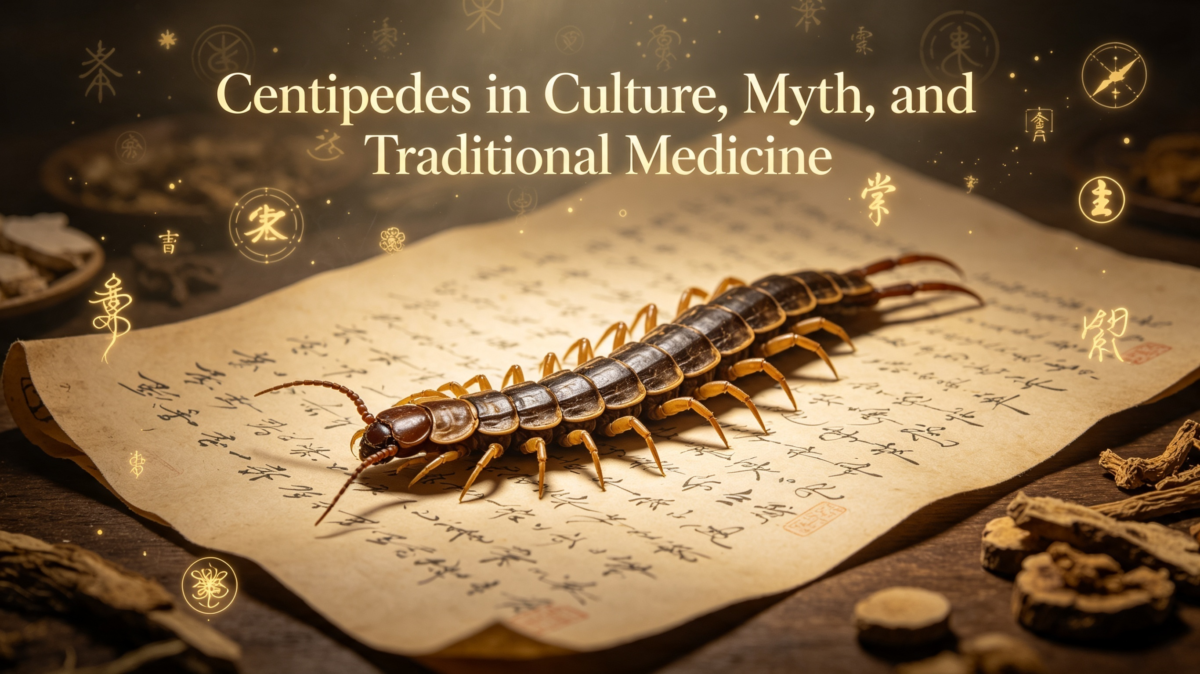
Centipedes in Culture, Myth, and Traditional Medicine
For thousands of years, the sight of a centipede has evoked a profound visceral reaction in humans. With its dozens of undulating legs, venomous bite, and preference for the dark, damp shadows of the world, the centipede has naturally woven itself into the mythological tapestry of cultures across the globe. Beyond the realm of folklore and fear, however, the centipede has also been recognized for its potent biological properties, securing a permanent place in traditional medicine. Today, as modern science begins to decode the complex chemistry of centipede venom, the ancient myths and traditional remedies are finding surprising validation in the laboratory.
The Five Venomous Creatures: Centipedes in Chinese Mythology
In Chinese culture and folklore, the centipede holds a prominent and somewhat ominous position. It is most famously known as one of the "Five Venomous Creatures" (Wu Du), a group of animals believed to embody dark, toxic energies. The group typically includes the centipede, the scorpion, the toad, the viper, and the centipede's frequent rival, the millipede (or sometimes the spider, depending on the region).
According to traditional beliefs, these creatures were at their most dangerous during the Dragon Boat Festival (Duanwu) in early summer, when the weather became hot and humid, and venomous animals were most active. To ward off disease and bad luck, people would draw pictures of the Five Venomous Creatures on their doors or wear amulets featuring them. Paradoxically, while the centipede was feared as a symbol of toxicity, its image was also used in sympathetic magic to repel actual venomous bites—believing that the image of the centipede would scare away real scorpions and snakes.
The Fearsome Mukade: Centipedes in Japanese Folklore
In Japanese mythology, the giant centipede, known as the Mukade, is a creature of immense terror and power. Unlike the smaller, everyday centipedes, the mythological Mukade is depicted as a monstrous, dragon-sized beast that terrorized the countryside.
The most famous legend of the Mukade is the tale of Fujiwara no Hidesato, a legendary Heian-period warrior. According to the myth, a giant Mukade was encircling Mount Mikami, its massive body causing earthquakes and its toxic breath poisoning the land. While the Emperor's armies failed to defeat the beast, Hidesato faced the monster armed only with his bow and arrows. He discovered that the Mukade was invulnerable to normal weapons but was fatally allergic to human saliva. Hidesato coated the tip of his final arrow with his own spit and shot it into the creature's head, slaying the beast. This legend cemented the centipede in Japanese culture as a symbol of a formidable, almost supernatural adversary that requires great courage and cunning to defeat.
Omens of the Dark: Centipedes in Western Folklore
In European folklore, the centipede did not achieve the mythological grandeur of the Asian Mukade, but it was still viewed with deep suspicion. Because of its many legs, venomous nature, and habit of hiding in dark, decaying places, the centipede was often associated with witchcraft, dark magic, and the devil.
In various rural European traditions, seeing a centipede in the house was considered a bad omen, sometimes interpreted as a sign that a witch was watching the household or that disease was imminent. In some old English and Germanic folk remedies, the centipede was ironically used in sympathetic magic; it was believed that burning a centipede or carrying its dried body could cure earaches or protect against the bites of other venomous creatures. Despite these uses, the centipede largely remained a creature of the macabre in the Western imagination, a symbol of the creepy, crawling dangers of the natural world.
Ancient Healing: Centipedes in Traditional Medicine
While mythology often cast the centipede as a villain, traditional medicine recognized it as a powerful healer. This duality—poison and cure—is a common theme in ancient pharmacology, and the centipede is a prime example.
In Traditional Chinese Medicine (TCM), the dried body of the centipede (specifically Scolopendra subspinipes) is known as Wu Gong or Quan Xie. For over two millennia, it has been a staple in the TCM pharmacopeia. According to TCM principles, the centipede is acrid, warm, and highly toxic, but it possesses powerful properties that "dispel wind," unblock the body's meridians, and neutralize toxins.
Historically, Wu Gong was prescribed to treat a wide array of severe conditions, including:
- Convulsions and Tetanus: Its ability to "extinguish wind" made it a primary treatment for spasms, seizures, and lockjaw.
- Toxic Sores and Boils: Applied topically or ingested in minute, carefully controlled doses, it was used to draw out infections and heal malignant ulcers.
- Snakebites and Scorpion Stings: Following the principle of "fighting poison with poison," centipede extracts were used as an antidote for other venomous bites.
- Rheumatic Joint Pain: Its meridian-unblocking properties made it a potent remedy for severe arthritis and chronic pain.
Beyond China, various indigenous medicinal practices across Asia, and even in parts of South America, have utilized centipedes. In some traditional Korean and Vietnamese medicines, centipede extracts or tinctures are used to treat inflammation, tuberculosis, and skin diseases.
Modern Science Meets Ancient Wisdom
For a long time, modern Western medicine viewed traditional centipede remedies with skepticism, dismissing them as primitive superstition. However, in the 21st century, advanced biochemical analysis has begun to validate what ancient healers knew intuitively: centipede venom is a pharmacological goldmine.
Researchers have discovered that the venom of the Scolopendra species contains a vast array of bioactive peptides and proteins. When scientists isolated these compounds and tested them in laboratory settings, the results were astonishing.
One of the most groundbreaking discoveries involves pain management. Researchers identified specific peptides in centipede venom (such as RhTx) that effectively block specific pain receptors (like the TRPV1 ion channel) in the nervous system. In animal models, these peptides have demonstrated analgesic effects that are comparable to, or even stronger than, morphine, but without the addictive properties or the respiratory depression associated with opioids. This discovery holds the potential to revolutionize the treatment of chronic pain.
Furthermore, other compounds found in the venom are being studied for their ability to regulate blood pressure, protect brain cells from ischemic damage (stroke), and even inhibit the growth of certain tumor cells. The ancient use of centipedes to treat cardiovascular and neurological issues is now being understood through the precise molecular interactions of these venom peptides.
Conclusion: From Mythological Monster to Medical Marvel
The journey of the centipede through human history is a fascinating reflection of our relationship with the natural world. For centuries, it was the stuff of nightmares—a mythical monster in Japan, a symbol of toxic evil in China, and an omen of dark magic in Europe. Yet, alongside this fear, ancient healers recognized its profound medicinal power, utilizing its very venom to cure the ailments that plagued humanity.
Today, as modern science decodes the complex chemistry of its venom, the centipede is transitioning from a creature of myth and folklore into a beacon of modern pharmacological hope. It stands as a powerful reminder that the most terrifying aspects of nature often hold the deepest secrets to healing, and that the wisdom of ancient traditional medicine can still illuminate the path for modern scientific discovery.