

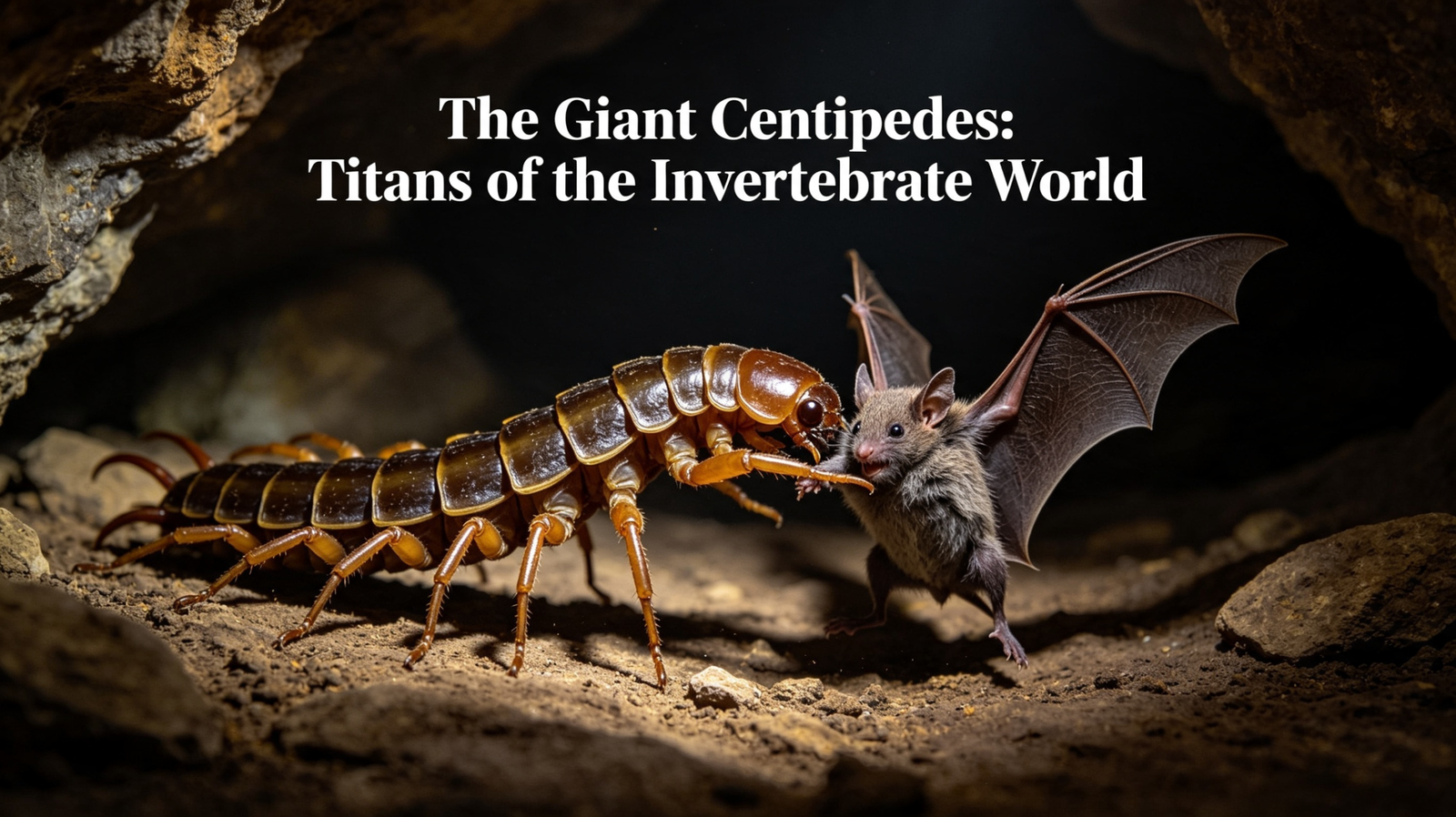
The Giant Centipedes: Titans of the Invertebrate World
When most people think of centipedes, they picture the small, fragile, and incredibly fast house centipede scurrying across a basement floor. However, hidden in the dense, humid undergrowth of tropical rainforests and the dark recesses of cave systems roam the true titans of the myriapod world. The giant centipedes, primarily belonging to the order Scolopendromorpha, are the apex predators of the invertebrate realm. Reaching impressive sizes, possessing immense physical power, and wielding a highly potent venom, these creatures are a testament to the extreme evolutionary capabilities of arthropods.
The Amazonian Giant: Scolopendra gigantea
The undisputed heavyweight champion of the centipede world is the Amazonian Giant Centipede (Scolopendra gigantea). Native to the tropical rainforests and cave systems of northern South America, including Venezuela and the island of Trinidad, this colossal arthropod can reach staggering lengths of up to 12 inches (30 centimeters). To put this into perspective, it is roughly the size of a standard dinner plate.
The Amazonian giant is not just large; it is a highly specialized and fearless predator. While smaller centipedes stick to insects, S. gigantea regularly hunts large tarantulas, frogs, lizards, and even small rodents. Its most famous and astonishing predatory behavior, however, was documented in cave systems. Researchers have observed these giant centipedes clinging to the walls and ceilings near cave entrances, using their powerful legs to anchor themselves. When a small bat flies too close or rests on the cave wall, the centipede strikes with lightning speed, grabbing the bat with its legs and dragging it down to the cave floor to be consumed. This makes the Amazonian giant one of the very few invertebrates known to regularly prey on mammals.
The Asian Giant: Scolopendra subspinipes
While the Amazonian giant holds the record for size, the Asian Giant Centipede (Scolopendra subspinipes, also frequently referred to as Scolopendra dehaani) is perhaps the most widespread and notorious. Found across a massive geographic range stretching from India and southern China through Southeast Asia, and down to Australia, this species is a highly adaptable and aggressive hunter.
Often characterized by a striking reddish-orange head and a dark, heavily armored body, the Asian giant can grow up to 8 inches (20 centimeters) in length. Unlike the ambush tactics of some of its relatives, S. subspinipes is an active and highly aggressive forager. It is known for its fierce temperament; when threatened, it will readily rear up, spread its massive forcipules, and strike repeatedly. Its potent venom and powerful bite make it a formidable opponent, capable of subduing large beetles, scorpions, and small vertebrates with ease.
Anatomy of a Titan: Built for Power
To achieve and maintain such massive sizes, giant centipedes have evolved specific anatomical adaptations that set them apart from their smaller cousins.
- Robust Exoskeleton: Giant centipedes possess a much thicker and more heavily calcified exoskeleton than smaller species. This thick armor protects them from the struggles of large prey, such as the crushing mandibles of tarantulas or the stingers of scorpions, and provides a formidable defense against vertebrate predators like birds and small mammals.
- Massive Forcipules: Their venom-injecting front legs (forcipules) are proportionally much larger and thicker. These pincers are incredibly strong, capable of piercing the thick skin of small mammals and the heavy exoskeletons of large tarantulas. The muscles controlling the forcipules are highly developed, allowing them to deliver a vice-like grip once they latch onto prey.
- Potent Venom Glands: To subdue large and dangerous prey quickly, giant centipedes require a massive payload of venom. Their internal venom glands are highly developed, producing a complex and concentrated cocktail of neurotoxins and cytotoxins that can paralyze a tarantula or a small mouse in seconds.
Ecological Role: Apex Predators of the Micro-World
In the complex food web of the tropical forest floor, giant centipedes occupy a crucial position as apex invertebrate predators. Because they are at the top of the invertebrate food chain, they play a vital role in regulating the populations of other large arthropods. By preying on large herbivorous insects and formidable predators like tarantulas and scorpions, they prevent any single species from dominating the ecosystem.
Furthermore, their ability to hunt small vertebrates links the invertebrate and vertebrate food webs. They convert the biomass of insects and small animals into their own tissue, which in turn provides a high-protein food source for larger vertebrate predators, such as snakes, large spiders, birds, and mongooses, which are among the few animals equipped to safely hunt a giant centipede.
Giants Among Us: Human Encounters and Medical Significance
Due to their size and aggressive nature, encounters between giant centipedes and humans are not uncommon in tropical regions. A bite from a giant centipede is a severe medical event. The massive forcipules can easily pierce human skin, injecting a large volume of venom. The resulting pain is often described as excruciating, radiating from the bite site and lasting for days, accompanied by severe swelling, fever, and localized tissue necrosis.
Despite the danger they pose, giant centipedes have been highly valued in human culture, particularly in traditional medicine. In Traditional Chinese Medicine (TCM), dried Scolopendra subspinipes (known as Quan Xie) has been used for centuries to treat conditions ranging from convulsions and tetanus to toxic sores and snakebites. It is believed to have strong "wind-expelling" and toxin-neutralizing properties.
Today, modern pharmacology is taking a keen interest in these giants. Researchers are isolating the specific peptides and proteins within the venom of giant centipedes to develop new pharmaceuticals. The venom contains compounds that block specific ion channels in the nervous system, showing immense promise for the development of novel, non-addictive painkillers and treatments for cardiovascular and neurological diseases.
Conclusion: Reigning Champions of the Undergrowth
The giant centipedes are the undisputed titans of the invertebrate world. Through millions of years of evolutionary refinement, species like the Amazonian Giant and the Asian Giant have perfected the art of the hunt, evolving the size, armor, and venom necessary to conquer prey far larger and more dangerous than themselves. While their formidable nature and painful bites command a healthy respect, their ecological importance and the medical potential hidden within their venom make them one of the most fascinating and vital predators on the planet. They are a powerful reminder that in the natural world, true giants do not only walk on two legs; some of the most formidable champions of the wild have dozens.