

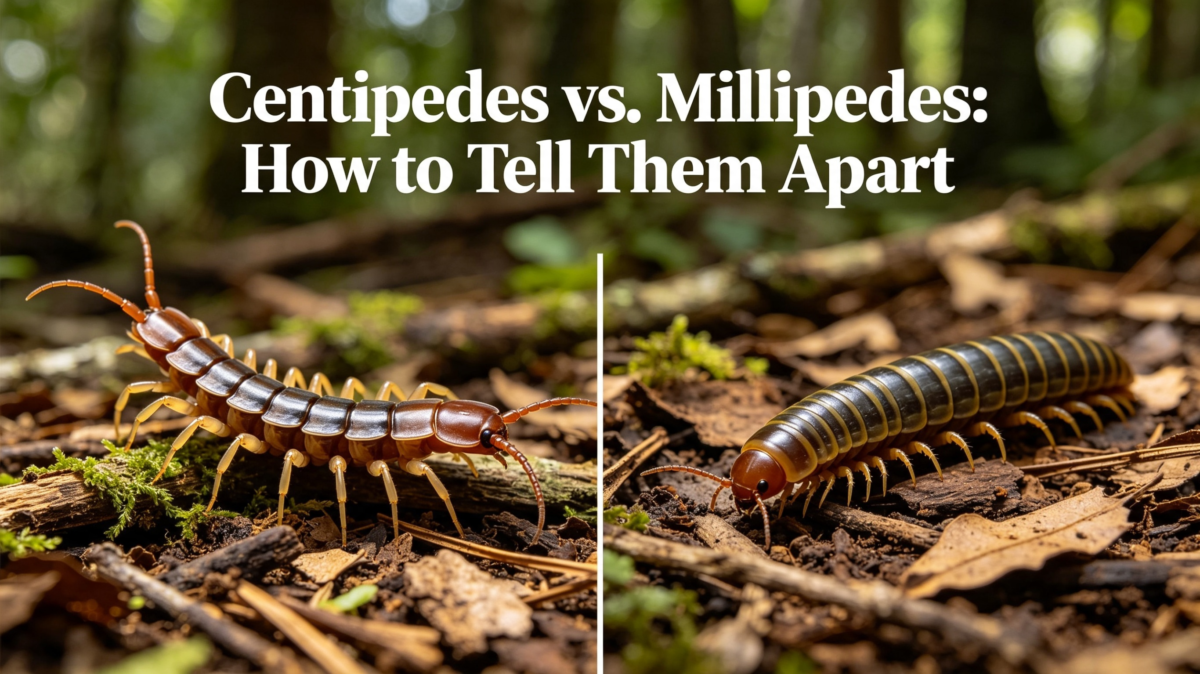
Centipedes vs. Millipedes: How to Tell Them Apart
When encountering a long, multi-legged creature scurrying across the forest floor or darting across a basement floor, the immediate reaction for many is a mix of shock and confusion. The most common question that follows is: "Is it a centipede or a millipede?" While both belong to the subphylum Myriapoda and share a superficial resemblance—elongated bodies with numerous legs—they are biologically, anatomically, and behaviorally distinct. Understanding the differences between these two creatures is not only fascinating from a biological standpoint but also practical, as their interactions with humans and their roles in the ecosystem are vastly different.
Taxonomic Divide: Two Distinct Lineages
Despite their similar appearance, centipedes and millipedes are not closely related. They diverged from a common ancestor hundreds of millions of years ago and evolved into entirely separate classes.
- Centipedes belong to the class Chilopoda. The name translates roughly to "hair foot," referring to their many legs.
- Millipedes belong to the class Diplopoda. The name translates to "double foot," which is the key to understanding their most defining anatomical feature.
This evolutionary split means that their similarities are largely the result of convergent evolution—adapting to similar environments (dark, damp, terrestrial) rather than sharing a recent common ancestor.
The Leg Count: The Most Reliable Identifier
The most definitive way to tell a centipede from a millipede is by looking at their legs and how they attach to their body segments. Despite their names implying "hundred" and "thousand" legs, neither actually has that exact number, but the arrangement is a dead giveaway.
Centipedes: One Pair Per Segment
Centipedes have exactly one pair of legs attached to each body segment. Their legs are long, extend outward from the sides of their bodies, and are highly visible. The first pair of legs is modified into venomous forcipules (fangs) located right behind the head, which are used to strike and subdue prey.
Millipedes: Two Pairs Per Segment
Millipedes have two pairs of legs on most of their body segments. This happens because their body segments are fused together into rings called diplosegments. Because they have twice as many legs packed into each segment, their legs are shorter, point downward rather than outward, and are often tucked beneath the body, making them look like they are rowing as they move.
Body Shape and Posture
If the legs are hard to count, the overall body shape provides a quick visual clue.
- Centipedes have a dorsoventrally flattened body (flat from top to bottom). This gives them a somewhat streamlined, almost leech-like appearance, allowing them to slip into tight crevices and flatten themselves against surfaces.
- Millipedes have a cylindrical or tubular body shape, resembling a worm or a piece of wire. Some species may be slightly flattened, but they generally appear rounder and more robust than centipedes.
Movement and Speed
The way these creatures move reflects their ecological roles and physical build.
Centipedes are built for speed. Their long legs and flattened bodies allow them to be incredibly fast and agile. When disturbed, a centipede's first instinct is to sprint away at startling speeds, darting erratically to escape predators or pursue prey. They are the sprinters of the myriapod world.
Millipedes, on the other hand, are slow and deliberate. Their short, downward-pointing legs are designed for pushing through soil and leaf litter rather than running. When a millipede moves, it creates a rippling, wave-like motion down its body. They are the slow crawlers of the undergrowth.
Diet and Ecological Role
Perhaps the most crucial difference between the two lies in what they eat, which dictates their mouthparts and their role in the ecosystem.
Centipedes: The Predators
Centipedes are strictly carnivorous. They are active hunters that feed on live prey, including insects, spiders, worms, and occasionally small vertebrates. They rely on their speed and their venomous forcipules to capture and paralyze their meals. In the ecosystem, they act as apex invertebrate predators and natural pest controllers.
Millipedes: The Recyclers
Millipedes are primarily detritivores. They feed on decaying organic matter, such as rotting leaves, wood, and plant debris. They possess strong mandibles designed for chewing and grinding tough plant material. In the ecosystem, millipedes are vital decomposers, breaking down dead plant matter and returning essential nutrients to the soil.
Defense Mechanisms: Venom vs. Chemical Warfare
When threatened, centipedes and millipedes employ entirely different defensive strategies.
Centipedes rely on their speed to flee. If cornered or handled, they will use their venomous forcipules to bite in self-defense. As noted in previous articles, while a centipede bite is painful and can cause localized swelling, it is rarely dangerous to humans. However, larger species can deliver a genuinely nasty bite.
Millipedes cannot bite humans, as their mouthparts are designed for crushing leaves, not piercing skin. Instead, their primary defense mechanism is to curl their body into a tight, protective coil, shielding their soft underside and legs. Many millipede species also possess specialized glands along their bodies that secrete foul-smelling, irritating, and sometimes toxic liquids. These secretions can contain hydrogen cyanide, benzoquinones, or other noxious chemicals that deter predators like ants, birds, and mammals. If a millipede's secretions get on human skin, it can cause discoloration, irritation, or mild chemical burns, and it is highly dangerous if it gets into the eyes.
Antennae and Vision
A closer inspection of their heads reveals further differences.
- Antennae: Centipedes have long, filamentous, and highly mobile antennae that they constantly sweep back and forth to sense their environment. Millipedes have shorter, elbowed (bent) antennae that are less mobile and primarily used for tactile sensing in close proximity.
- Eyes: Most centipedes possess simple eyes (ocelli) that can detect light and dark, and some species have clusters of simple eyes that form a rudimentary compound eye. Millipedes also have simple eyes, but they are typically arranged in distinct, grouped patches on the sides of their head, or they may be entirely eyeless in subterranean species.
Summary: A Quick Field Guide
To easily remember the differences, you can use this quick mental checklist when you encounter a many-legged creature:
- Body Shape: Flat (Centipede) vs. Round/Cylindrical (Millipede).
- Legs per Segment: One pair (Centipede) vs. Two pairs (Millipede).
- Leg Position: Stick out to the sides (Centipede) vs. Tucked underneath (Millipede).
- Speed: Fast sprinter (Centipede) vs. Slow crawler (Millipede).
- Diet: Meat/Predator (Centipede) vs. Decaying plants/Decomposer (Millipede).
- Defense: Venomous bite (Centipede) vs. Curling up and secreting foul chemicals (Millipede).
Conclusion: Appreciating Both Creatures
While it is easy to lump centipedes and millipedes together as "creepy crawlies," taking a closer look reveals two entirely different evolutionary success stories. Centipedes are the fierce, venomous hunters of the shadows, keeping insect populations in check. Millipedes are the gentle, armored recyclers, quietly breaking down the forest floor to nourish the next generation of plant life. By learning to tell them apart, we not only satisfy our curiosity but also gain a deeper appreciation for the diverse and complex web of life thriving right beneath our feet.