

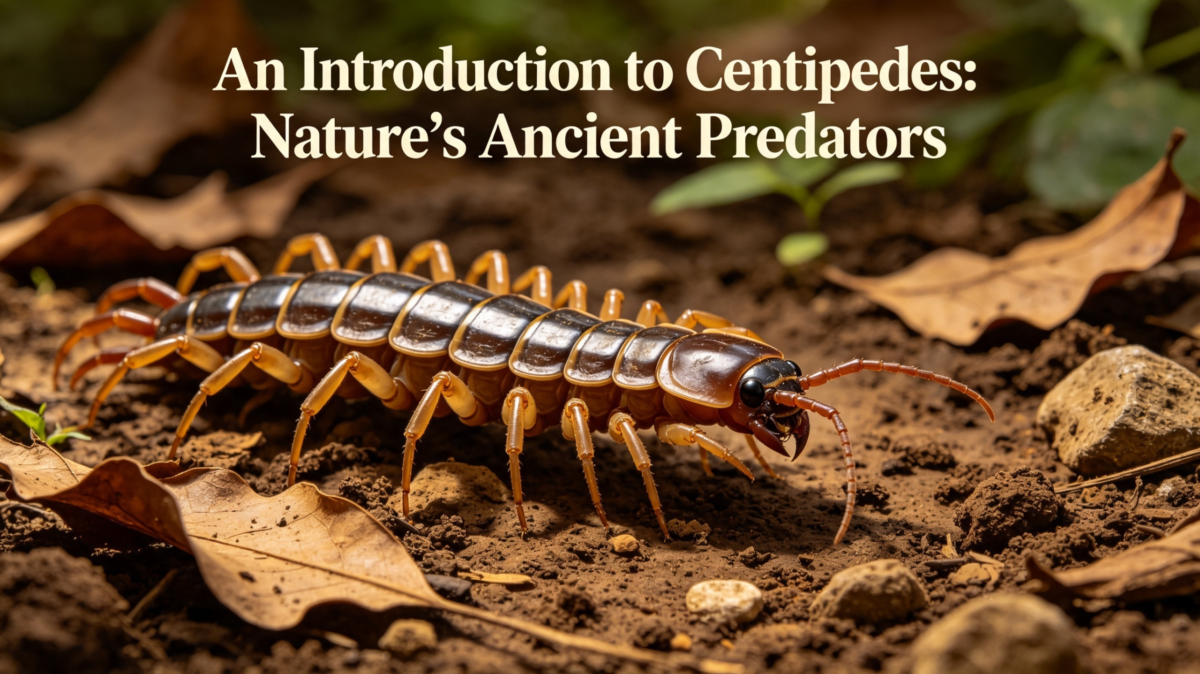
An Introduction to Centipedes: Nature’s Ancient Predators
Centipedes, belonging to the class Chilopoda within the subphylum Myriapoda, are among the most fascinating and misunderstood creatures in the animal kingdom. Despite their name, which translates literally to "hundred legs," no known species possesses exactly one hundred legs. The number of leg pairs varies dramatically across different species, ranging from fewer than 20 to over 300, but they always feature an odd number of pairs. Today, scientists have identified approximately 3,000 species of centipedes worldwide. Far from being mere household pests, these ancient arthropods are highly specialized predators that have played a crucial role in terrestrial ecosystems for hundreds of millions of years.
The Evolutionary Marvel: A 400-Million-Year Legacy
To truly appreciate the centipede, one must look back into the deep past. Centipedes are part of an ancient lineage that makes them one of the earliest known groups of animals to transition from aquatic environments to land. Fossil evidence suggests that myriapods, the broader group that includes centipedes and millipedes, were walking on land during the Late Silurian period, over 400 million years ago. This means they were prowling the prehistoric landscapes long before the first dinosaurs appeared, and even before the evolution of amphibians.
This incredible evolutionary success is a testament to their highly adaptable body plan. While many ancient species went extinct during mass extinction events, centipedes survived by retreating into the moist, sheltered microhabitats of the soil and leaf litter. Their basic anatomical structure has remained remarkably consistent over millions of years, proving that their design as elongated, multi-legged predators was perfectly suited for their ecological niche.
Taxonomic Diversity: The Five Orders of Centipedes
The class Chilopoda is incredibly diverse, divided into five distinct orders, each with unique physical characteristics and ecological preferences:
- Scutigeromorpha (House Centipedes): Perhaps the most familiar to humans, these centipedes are known for their incredibly long, fragile legs and remarkable speed. They are highly adapted to living in dark, damp areas, including human dwellings, where they act as excellent natural pest controllers.
- Lithobiomorpha (Soil Centipedes): These are the most widespread and commonly encountered centipedes in temperate regions. They have short, robust legs and are typically found hiding under rocks, logs, and leaf litter in forests and gardens.
- Scolopendromorpha (Tropical Giant Centipedes): This order contains some of the largest and most formidable centipedes in the world, including the infamous Amazonian Giant Centipede. They possess powerful venom and can subdue relatively large prey, including small vertebrates.
- Geophilomorpha (Snake-like Centipedes): These centipedes are highly specialized for a subterranean lifestyle. They have elongated, worm-like bodies with up to 191 leg pairs, and lack eyes entirely, relying solely on their antennae to navigate through the soil.
- Craterostigmomorpha: The rarest and most enigmatic order, containing only a single known species found in specific regions of New Zealand and Tanzania. They represent a unique evolutionary branch that bridges the gap between other centipede orders.
Ecological Significance: The Apex Invertebrate Predators
In the complex web of terrestrial ecosystems, centipedes occupy a vital position as apex invertebrate predators. Unlike many other soil-dwelling arthropods that feed on decaying plant matter, centipedes are strictly carnivorous. They are active hunters that patrol the forest floor, feeding on a wide variety of insects, spiders, worms, and other small invertebrates.
By preying on these organisms, centipedes help regulate invertebrate populations, preventing any single species from becoming overly dominant. In agricultural and forest ecosystems, this predatory behavior is highly beneficial, as they consume many species that are considered pests. Furthermore, centipedes serve as an important food source for a variety of larger animals, including birds, reptiles, amphibians, and small mammals, thus acting as a crucial link in the food chain.
Anatomy of a Survivor
The physical anatomy of a centipede is a masterpiece of evolutionary engineering. Their bodies are flattened dorsoventrally, allowing them to easily slip into narrow crevices and tight spaces to escape predators or ambush prey. The most defining feature of their anatomy is the modification of their first pair of legs into forcipules. These venomous, claw-like appendages are connected to venom glands and are used to inject toxins into their prey, paralyzing them almost instantly.
Despite their formidable hunting tools, centipedes have one major vulnerability: they are highly susceptible to desiccation. Unlike insects, which have a waxy outer layer on their exoskeleton to retain moisture, centipedes lose water rapidly through their cuticle. This biological limitation dictates their behavior and habitat choices, forcing them to remain in humid environments and driving their nocturnal lifestyle to avoid the drying heat of the sun.
Conclusion: Respecting Nature's Ancient Hunters
Centipedes are far more than the creepy, multi-legged creatures that often startle us when we turn on a basement light. They are ancient survivors, holding a lineage that stretches back to the very dawn of terrestrial life. As apex invertebrate predators, they play an indispensable role in maintaining the health and balance of ecosystems worldwide. By understanding their biology, evolutionary history, and ecological importance, we can shift our perspective from fear to a deep respect for these remarkable and ancient predators of the undergrowth.